
Critical Steps to Take After Being Hit While Cycling
Your priority after a crash is your health and safety. The actions you take at the scene can also be crucial for protecting your legal rights.
Step 1: Get to Safety and Call 911
If you can, move yourself and your bicycle out of the path of traffic. Call 911 immediately to report the crash and request paramedics. An official police report is vital for establishing the facts of the incident.
Step 2: Always Accept Medical Evaluation
Even if you think you can "walk it off," accept transport to a hospital or see a doctor right away. Adrenaline can mask serious internal injuries or head trauma. A documented medical record is essential for your injury claim.
Step 3: Document the Scene and Driver Info
If you are able, use your phone to take photos of the car, your bicycle, the positions of both, and any skid marks or road hazards. Get the driver's name, license, and insurance information, as well as contact info for any witnesses.
Step 4: Preserve Your Equipment
Do not repair or throw away your damaged bicycle, helmet, or any of your gear. They are important pieces of evidence. Your cracked helmet can be powerful proof of the force of impact.
Your Rights as a Cyclist in California
Many drivers, and even some police officers, are unaware of the laws that protect cyclists. This lack of knowledge often leads to unfair blame being placed on the rider after a crash.
As your advocates, our first job is to establish the facts. You are not a guest on the road; you are a legal road user with clearly defined rights. We use the law as both a shield to protect you and a sword to hold negligent drivers accountable.
You Have a Right to the Road
The single most important principle of California bicycle law is that cyclists have the same rights and are subject to the same rules as the drivers of motor vehicles. You are not an obstacle; you are a vehicle.
This principle is the foundation of your injury claim. It means a driver who fails to yield to you, cuts you off, or follows too closely is not just being rude; they are breaking the law and are negligent. Insurance adjusters may try to argue that you shouldn't have been on the road at all. We immediately shut down this baseless argument by citing your legal right to be there.
In every case, we frame the incident from this position of strength. We establish that you were legally operating your bicycle where you were allowed to be, and the driver of the car, truck, or bus failed in their legal duty to share the road safely with you.
The "Three Feet for Safety Act" (CVC § 21760)
To combat the danger of "close calls" and side-swipes, California enacted a specific law to protect cyclists. The "Three Feet for Safety Act" requires the driver of a motor vehicle to provide at least three feet of space between their vehicle and a cyclist when passing.
This law provides a clear, measurable standard for driver negligence. If a driver passes you with less than three feet of clearance and causes a crash, it is powerful evidence that they violated the law and are at fault. This is especially critical in cases where there is no direct impact, such as when a driver buzzes a cyclist too closely, causing the rider to swerve and crash.
We meticulously investigate accidents caused by unsafe passing. We use:
- Witness testimony: Finding other drivers or pedestrians who saw the vehicle pass dangerously close to you.
- Video evidence: Obtaining footage from traffic cameras, dashcams, or security cameras that can show the proximity of the vehicle.
- Expert analysis: Analyzing the final resting positions of the bike and vehicle to help establish an unsafe passing maneuver.
We use California Vehicle Code § 21760 not just as a guideline, but as a legal tool to prove a driver's clear violation of their duty to pass safely.
Common Causes of Bicycle Accidents in the Valley
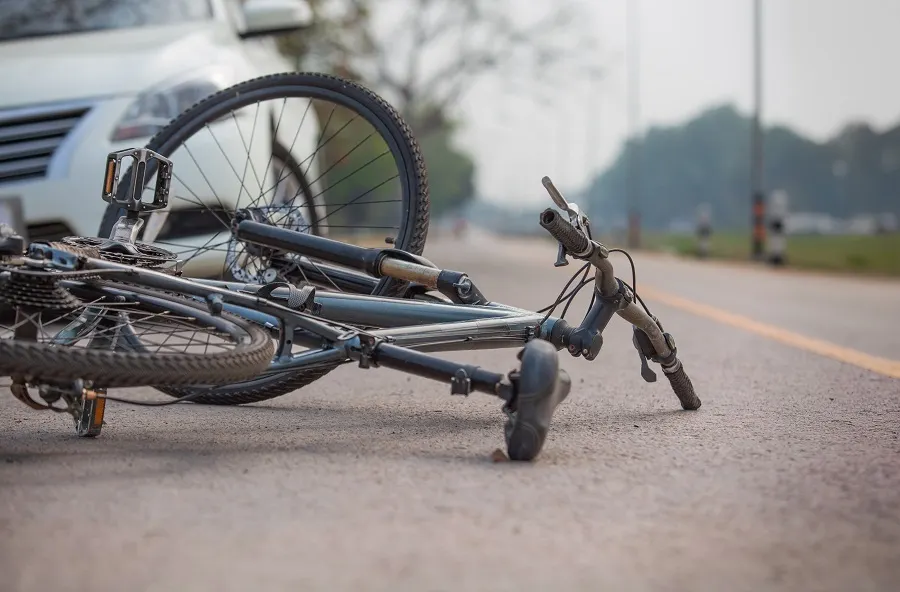
Most bicycle accidents are not random events; they are predictable collisions caused by driver inattention. As experienced advocates for cyclists, we have seen these dangerous patterns time and again. We know how to investigate these common crash types to prove driver negligence.
"Dooring" Accidents and Unsafe Exits from Parking Spaces
A "dooring" accident occurs when a driver or passenger of a parked car opens their door directly into the path of an oncoming cyclist. A similar danger occurs when a driver pulls out of a curbside parking space without checking their blind spot for a cyclist in the bike lane.
These accidents are almost always the fault of the person in the motor vehicle. California Vehicle Code § 22517 legally requires a person to check that it is "reasonably safe" before opening their car door into traffic. There is no excuse for failing to look. Despite this, insurance companies will often try to blame the cyclist for not being able to swerve in time.
We counter this defense by proving the cyclist had no chance to avoid the collision. We gather evidence to show:
- You were riding in a designated bike lane or a safe distance from parked cars.
- The door opened suddenly and without warning.
- Swerving would have put you in the path of moving traffic, making the driver's action the sole cause of the dangerous situation.
"Right Hooks" and "Left Crosses" at Intersections
The vast majority of serious bicycle accidents occur at intersections. The two most common scenarios have specific names:
- The "right hook": A car passes a cyclist on the left and then makes an immediate right turn directly into the cyclist's path.
- The "left cross": A car making a left turn fails to see an oncoming cyclist and turns directly in front of them.
In both of these scenarios, the driver has violated the cyclist's right-of-way. They either failed to yield to oncoming traffic (the "left cross") or made an unsafe lane change and turn (the "right hook"). These are clear acts of driver negligence.
Proving these cases requires a detailed reconstruction of the moments before the crash. We use:
- Witness interviews: To establish the cyclist's speed and position on the road.
- Traffic signal data: To confirm who had the green light.
- Vehicle "black box" data: To show the driver's speed and braking patterns, often revealing they never slowed down or looked for the cyclist before turning.
We build a clear, second-by-second narrative of the driver's failure to yield, leaving their insurance company with no room to argue.
Proving Driver Negligence and Valuing Your Claim
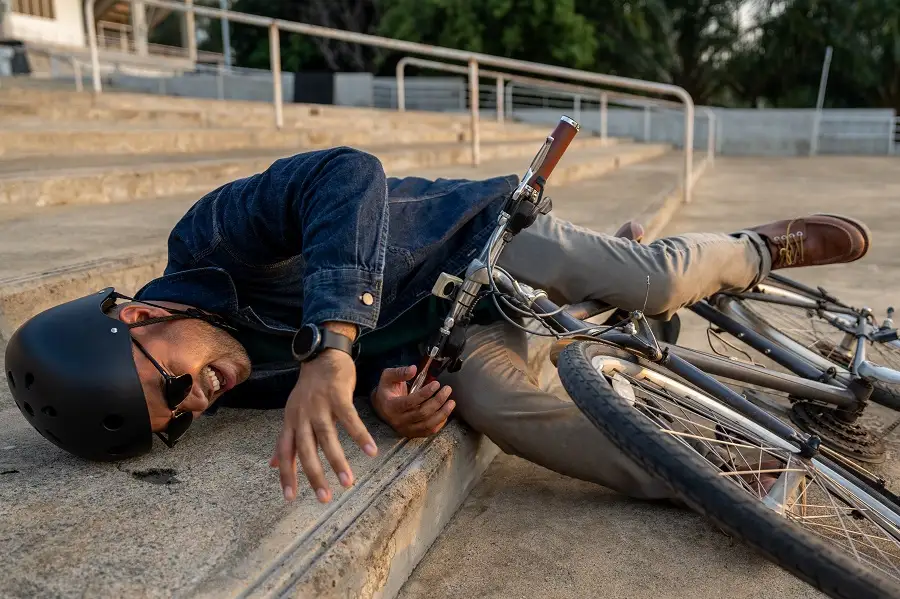
After a crash, you face two battles: proving the driver was at fault, and proving the true value of your losses. Insurance companies will fight you on both fronts, relying on unfair biases and lowball valuation tactics. As your legal team, we have a specific, detailed process for overcoming these challenges and securing the full compensation you deserve.
Countering the "I Didn't See the Cyclist" Defense
The most common and frustrating excuse a driver gives after hitting a cyclist is, "I just didn't see them." We know this is not a legal defense; it is an admission of their failure to pay attention and safely share the road.
An insurance adjuster will use this statement to imply that you were somehow invisible or not where you were supposed to be. They will try to shift the blame to you. Our job is to prove that you were visible and that the driver's negligence was the sole cause of the collision.
We dismantle this defense with facts and evidence, not excuses. Our investigation includes:
- Obtaining vehicle "black box" data: We can often secure data from the car's event data recorder (EDR). This can show the driver's speed and whether they braked before impact, which is crucial for proving whether they saw you or not.
- Analyzing sightlines and conspicuity: We use accident reconstruction experts to analyze the driver's line of sight and establish that a reasonably attentive driver would have had a clear and unobstructed view of you.
- Using witness testimony: We find and interview witnesses who can confirm your position on the road, your direction of travel, and the driver's actions leading up to the crash.
We build a powerful narrative that reframes the driver's excuse from "I didn't see the cyclist" to "I failed to see the cyclist because I was not paying attention."
Recovering the Full Value of Your Bicycle and Gear
For many cyclists, a bicycle is a high-performance machine and a significant investment, often worth thousands of dollars. We know that your bike and gear are not easily replaced, and we reject the lowball "book value" offers that insurance companies try to make.
An insurance adjuster may treat your carbon fiber road bike like a simple piece of sporting goods. They will not understand the value of individual components, custom fittings, or essential safety gear. This leads to offers that are a fraction of the true replacement cost, leaving you to cover the difference.
We treat your property damage claim with the seriousness it deserves. Our process includes:
- Creating a detailed inventory: We work with you to create a comprehensive list of every damaged item, from the frame and wheels to the groupset, pedals, and accessories like a GPS computer.
- Obtaining expert valuations: We gather your original purchase receipts and can work with expert appraisers from reputable local bike shops to provide a current, full replacement value for your bicycle and all of its custom components.
- Demanding full replacement of safety gear: We demand full compensation for your damaged riding gear, including your helmet replacement after a crash. A helmet is designed for only one impact and must be replaced after any crash, even if the damage is not visible. We ensure the cost of a new, high-quality helmet is included in your claim.
We fight to make sure you get the resources to either professionally repair your bike to its pre-accident condition or replace it with a new one of the same quality and value.